INTERVIEW: K.B. Ferran (Playwright: “Judas and Peter Are Fucking”)
(K.B. Ferran uses he/him and she/her pronouns. I will use both interchangeably throughout the interview).
I meet K.B. the same place we first met years ago. Today, 4 P.M. on a Friday, Lotus Brew is less busy than usual. Max (the owner and barista) is free enough to deliver our drinks to our table. The cream floating on the top of my lavender latte is shaped into a small lotus flower.
The Queer Writer’s Group here at Lotus, which meets almost every Friday at 6 P.M., is a fertile ground for local talent, and its co-runner K.B. is no exception. I’ve just seen a performance of his first play at the Fountain Street Church over the weekend. It was fantastic. Many people laughed and more than a few cried. Almost two hundred people turned out to see K.B.’s biblical queer interpolation featuring a snarky, witty Judas, a devoted Peter, mysterious and aloof Jesus, and more than a few shots at John the Apostle.
I haven’t run an interview like this since working on my university paper, but I know the moment the play ends that I have to take a crack at it. K.B. tells me she’s never been interviewed before. I’m eager to be the first.
As we talk casually before the interview, K.B.’s very animated, with bright eyes, mobile hands, and a knowing smile. Slender and expressive, with short, dark hair, he’s dressed in shorts and flip-flops suitable for the heat wave.
Setting my phone between us to record, I start in at the beginning:
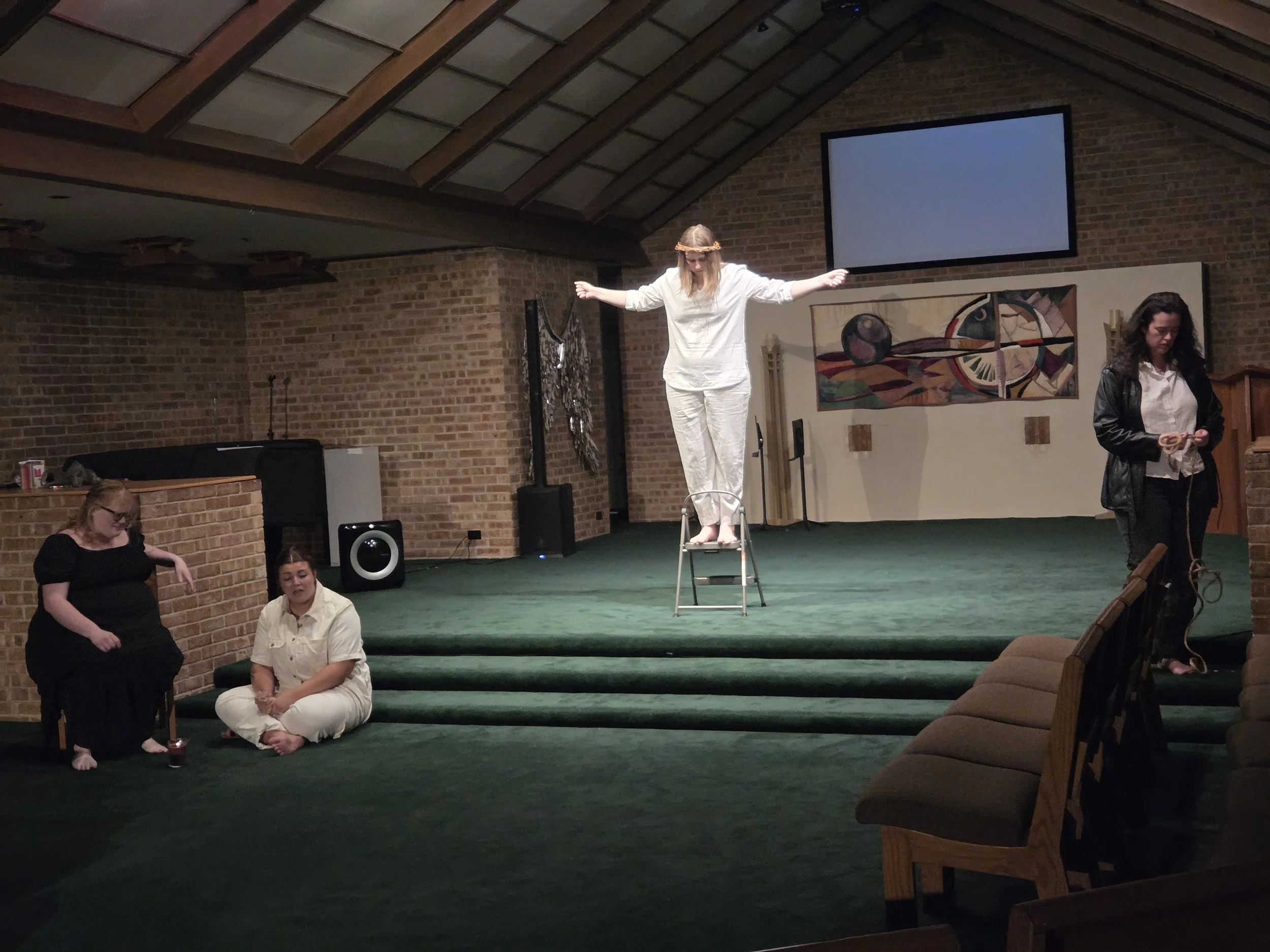
K.B.’s interpretation of Jesus on the cross, bordered by a denying Peter to the left and a pensive Judas to the right.
What was the very first thread of the idea for this play, and what led you to following that thread to its conclusion?
So, the first scene I actually wrote was the first scene of the show. And that scene had some of the least editing. It kind of came out fully formed.
The initial start of the idea was that I kept seeing people jokingly ‘shipping’ Judas and Jesus. And I'm like, "That's nice. They did kiss in the Bible, but maybe Judas could do better. Maybe Judas doesn't need that guy. Maybe there could be other guys."
And, you know, Peter was always a big focus in the Bible growing up. He was always falling short. And, yeah, at one point, Jesus back-to-back goes from saying, "Hey, you're the best, you're going to inherit my whole kingdom," to Peter saying the wrong thing and Jesus says, "Get behind me, Satan." And, ugh! That would be so devastating, if you love Jesus so much and he calls you Satan.
But then I had this idea of Judas making fun of him for it. I love the idea of, you just had this devastating moment where the person you want to impress the most, who you care for and respect the most, publicly humiliated you, and then this asshole comes around and starts teasing you for it.
So, that scene was the first I wrote. The easiest to write.
Now, writing a script is a very solitary endeavor. But putting on a play is obviously very collaborative. And this is your first play to come to stage. What was that like, handing it over to other people?
So, the first time I handed it over was actually a group read-through, and that was a bit more laid back. But from the beginning, I'd tell people I was writing a play, and they'd say, "Oh, so you're going to direct it?" And I'd say, "No. I'm not going to direct it, not if I can help it." And I think that's because I've always loved collaboration, and I've always assumed that I don't have the best way to do things.
It was scary handing it over to my director a bit, but I found someone that I trusted, and that's part of the ride. I want someone else to touch it and do what they want with it.
Now, interestingly, the play script has an all-male cast, but the play was put on by a group of women and non-binary people—who were phenomenal, by the way. Was that choice intentional on your part, or was it born from something else?
I mean, personally, I don't like when plays have an all-male cast. There's an extent to which, honestly, the more women are in a new play the more likely I'm going to go see it.
As for the casting, it could have gone a lot of different directions. I knew I didn't want it to be all men. But ultimately, the director and myself were both open to that. We both wanted it to be open casting, to encourage women and queer people to audition.
We had thirteen people show up. A lot of people gave really good reads, but with those three, the director and I were instantly nudging each other. "Okay, I think we have them." And, you know, even then I was letting the director choose who went where.
How did you find the director?
I have a friend who runs Fatal Femmes Cabaret, and she knows so many people. And, to an extent, I’m one of those people who she knows. She started this company about a year and a half ago and has already put on amazing, sold-out shows. And she does theater with Pigeon Creek, which is one of the ways that I got to know her better. So when I decided that I was going to produce the play this year, she was the first person that I reached out to. She said: “One, you can do the play with my cabaret production company,” which I’m still very grateful for and blessed with. I didn’t have to start social media from scratch.
But she also knew a director who has that experience, who can really dig into this text, who would love this idea. And so we sat down and I gave the pitch.
It was fun. They were in a cabaret show that night, so we were meeting earlier in the day before getting ready for it. And at the end of the conversation she said to let her think about it. “I’ll read the script and we can figure out the timing.” And then barely a few hours later, she says: “I haven’t read the script yet, but I really want to do it.”
That’s amazing!
We had a really great conversation, and we could tell that we clicked on our ideas about theater. You know?
Were there any major differences between how the play lived in your head versus how the director brought it to life?
You know, when you're writing it, you have all of the lines set in a certain cadence. That changed, and that was something I was prepared to change. [The director] had the cast at the beginning of the show enter dressed all in white. I probably wouldn't have chosen that, but I love how it turned out. There were little things like that. And then, for example, in the scene where Peter walks on water. When I wrote that, I thought: "I don't know how they're going to do that. The director can figure that out."
[Laughs] Yeah.
And she did! She made it look cool. She kept it very simple, but very raw and beautiful. And so I really appreciate her.
Nothing major changed. You know, actors make choices, people say things in their own way. If anything, I wrote Judas to be funny. He has all the one-liners. He's crass. He's obnoxious, you know? He deflects with humor. But Peter ended up being really funny, too. And that was not something that I wrote, but the actor really played up the whole ‘goody two-shoes’ innocent way that got a lot of laughs.
So, speaking of these characters, for this play you were obviously working within the boundaries of the Bible, exploring the space between verses. Did you find the structure helpful, or was it more limiting? And, I would know this if I was more versed in the specific area of the Bible that you're referencing, but was there anything that you threw out entirely or had to change, as opposed to just adding context?
I definitely appreciated the biblical structure. I think that helped me finish it—especially as it was my first play and my first major writing project in years. I really liked that I could go back, look at the verses, and figure out what conversations would come from that, what conflicts would come from that.
In terms of things I found limiting, the final sequence of the Last Supper to the garden to the crucifixion, there's definitely a lot more in the Bible. So, I cut it down to its key components. A lot of that follows pretty closely on a scene-by-scene structure. And obviously I'm playing with it and I'm making it different, but Jesus is washing Peter's feet and Peter says, "No, Lord, you can't." And Peter denies Jesus three times, and all these moments… It took a lot to work in terms of what I wanted to keep.
If anything, there were a few times where I stripped the context a little bit more to make Jesus look not so good. There were one or two parts that a real dedicated Christian might say, "That's unfair to Jesus, that you had him stop at this sentence and not say that."
What was your specific incentive there?
There are a lot of plays and musicals that have come out since the '60s, where they take a lot more empathetic approach to Jesus.
I was coming at it with a lot more anger towards Jesus. Jesus did keep saying, "I'm going to leave you someday," and his disciples would ask, "What are you talking about?" and he'd shrug and not tell them. And Jesus knew Judas was going to betray him, and wanted him to do it because, you know—
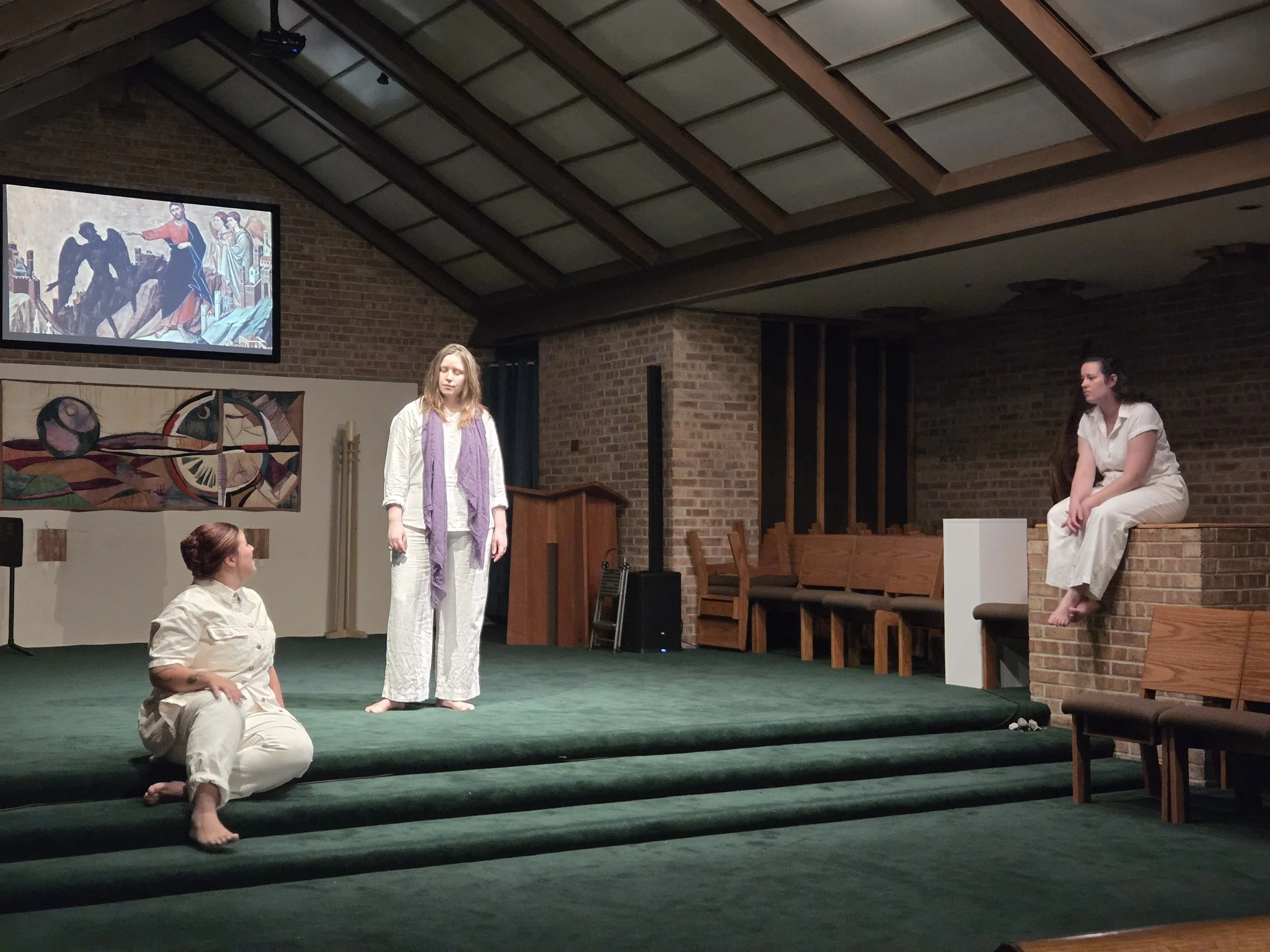
Jesus had an amazing presence throughout the play. Every time he entered a scene between Judas and Peter’s lovebird bickering, the entire atmosphere of the room shifted.
“I was coming at it with a lot more anger towards Jesus.”
He had to die somehow.
Yeah, he needed to be killed for God. “Ah, Judas, you’re a pawn in God’s plan, and Jesus doesn’t care about that.”
Ironically, kind of a martyr, right?
Yeah, he is a martyr. And he feels terrible about it. In the Bible, he kills himself because he feels so bad about it.
I was telling [my spouse] after the show, “all of those characters have a bad ending, by the way.”
It's a tragic story! Jesus has the best ending, because he got what he wanted. He wanted to die on the cross for everyone's sins, and he did. Good for him.
So, switching gears… On the playbook, you mentioned the importance of the Queer Writer’s Group in making this play happen. It’s hosted right here at Lotus Brew, and will meet in just a few hours. Can you elaborate on that importance?
I mean, first of all, I had not done a lot of writing. I had been working on the play for a while before I came to writers' group, but it was pretty haphazard. "Maybe I'll finish this someday." But then I started going to writers' group to make friends, and all of a sudden, "Wow, I have an hour to write every week, so I guess I should use it."
So part of it was the consistency, and a lot of it was the encouragement. Shout out to [Jacob Guajardo, co-host of the Writer’s Group], I sent him the script and he gave me line edits where the dialogue could be made sharper. Him doing that for a few scenes made me realize, "Oh, okay, I can do this, too."
People in writers' group encouraged me to do that first read-through just among friends, and that was great, too. To hear it said out loud, to hear everyone's opinions. Ultimately, a lot of it was the encouragement, and the interest, being able to tell people about it, and then being able to have a place to write it.
How are you feeling, moving forwards? Whenever I finish a project, by the end of it, I'm always itching to start on the next thing. But would you say that you feel similarly kind of rejuvenated and inspired, or are you mostly just relieved for the break?
The first couple of days out, I was relieved for the break, but I definitely want to do more. It’s given me a lot of audacity, I've been saying, especially because… Well, writing it is one thing, but to actually put it on and have to ask a million people for favors and organizing everything, that took a lot of… Tell me that I would do that five years ago and I would think you were crazy. But I did it, and it worked.
But, to answer your question, I don't have anything that's coming up soon. I don't have any finished scripts, but I really like how it turned out. I’d like to do more.
Do you feel like you had all of the support from the Grand Rapids community that you wished that you could have, or do you think that there's more that should be done to help queer voices that are interested in putting on plays locally?
I mean, there could always be more. I think it worked out for me with the connections that I had, and the fact that I was able to put a bit of my own starting capital up front. It helped that I wrote this play to be pretty simple, without many costuming or props or set needs. So, you know, a lot of things worked out for me.
But, yeah, a lot of people in Grand Rapids are doing cool stuff right now. There’s a local vintage store in town that does drag shows after hours. They just opened up the Four Star Theater again, which is an old movie theater where they do dance nights and drag and burlesque and all kinds of crazy stuff. So, yeah, I think we’ve always had a lot of theater in this town. We have a lot of colleges, a number of community theaters that are very established. And, they’re really good and put on good stuff. But I think, there is a bit of push and pull for the next group of people to do things on an even more independent level.
If you’re interested in putting on a performance of “Judas and Peter Are Fucking,” contact “judaspeterplay@gmail.com".
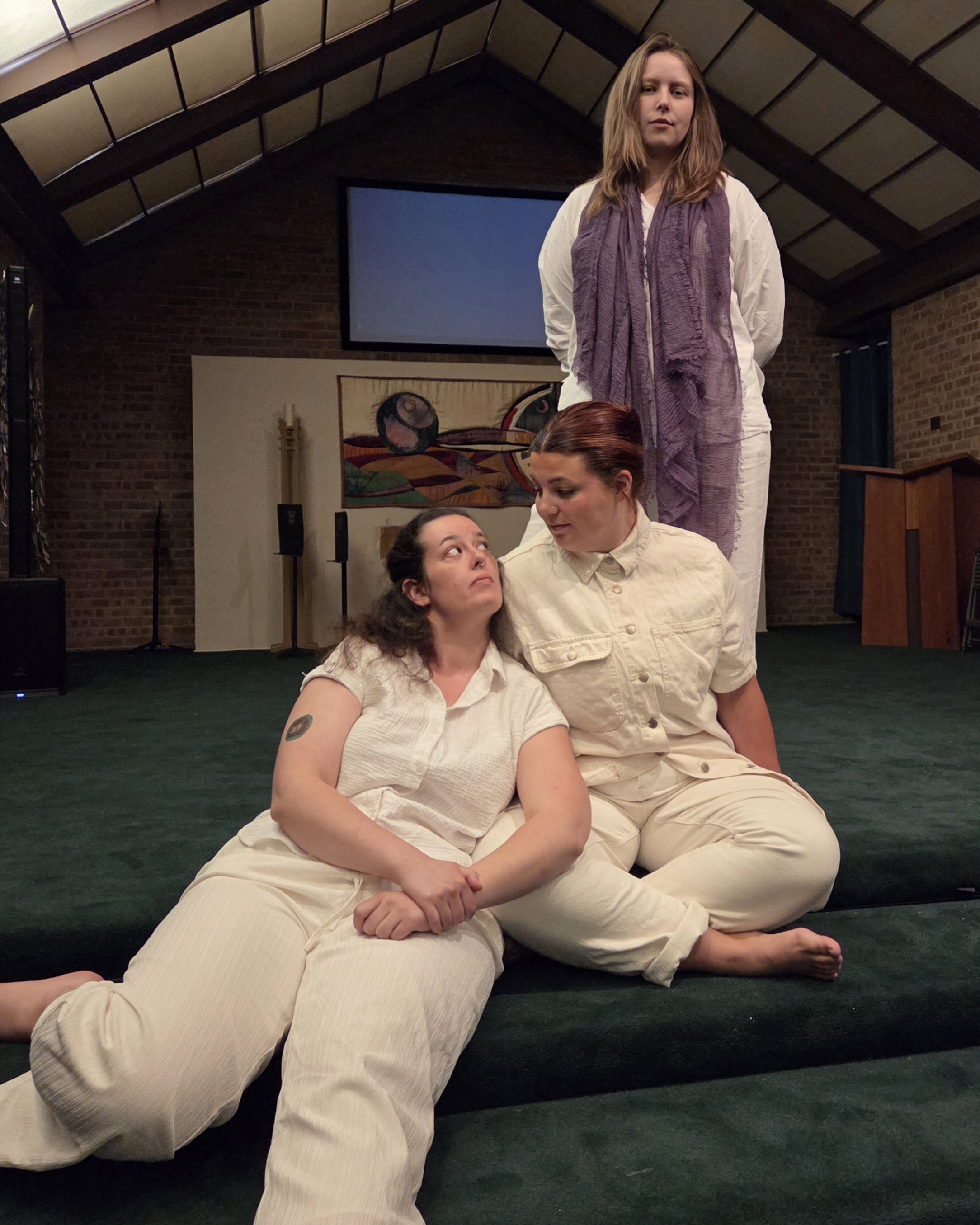
If you are a Grand Rapids based LGBT writer and are interested in being interviewed, send me an email at rosemary.mclean.grant@gmail.com.
If you are interested in my editing, ghostwriting, or beta reading services, check out my editorial services page here on my website!
